
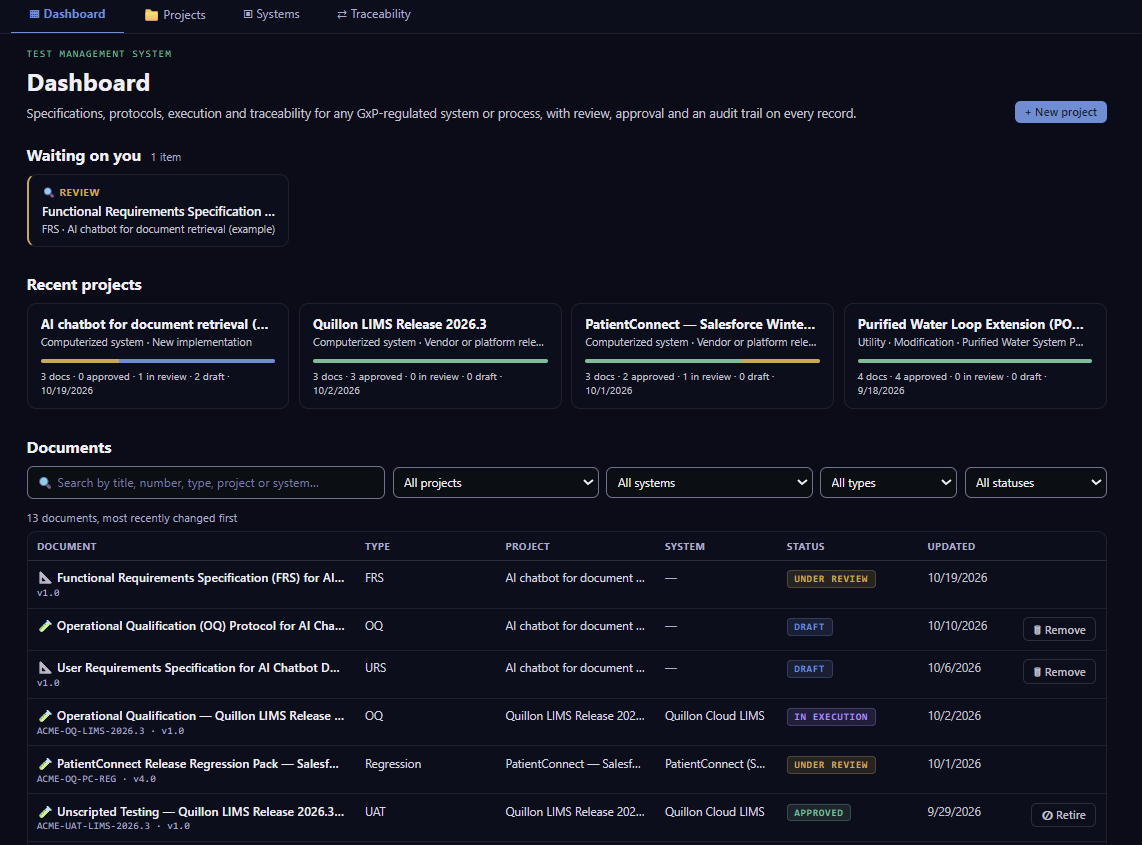
A document plan per project
Each line is new, a revision, an existing record, held elsewhere, or not needed with a rationale. Progress is read from the records themselves.
TMS / VALIDATION & TEST MANAGEMENT
Connect the purpose of a test to its protocol, review, approval, and execution evidence. AI assists with drafting; your validation team owns the strategy.
Explore in a tailored demo · See the sources, review steps, and records
TMS / VALIDATION & TEST MANAGEMENT
Move from specifications to protocols, execution, and review records. Keep proposed tests and inferred links subject to expert review.
Name the system and project type. List what is new, revised, reused, or not needed.
URS, FRS, and design specs, each requirement with an ID, priority, rigor, and rationale.
AI proposes test cases from approved specs. People review, sign, and run them.
Summary reports are built from the records: results, deviations, and trace gaps.
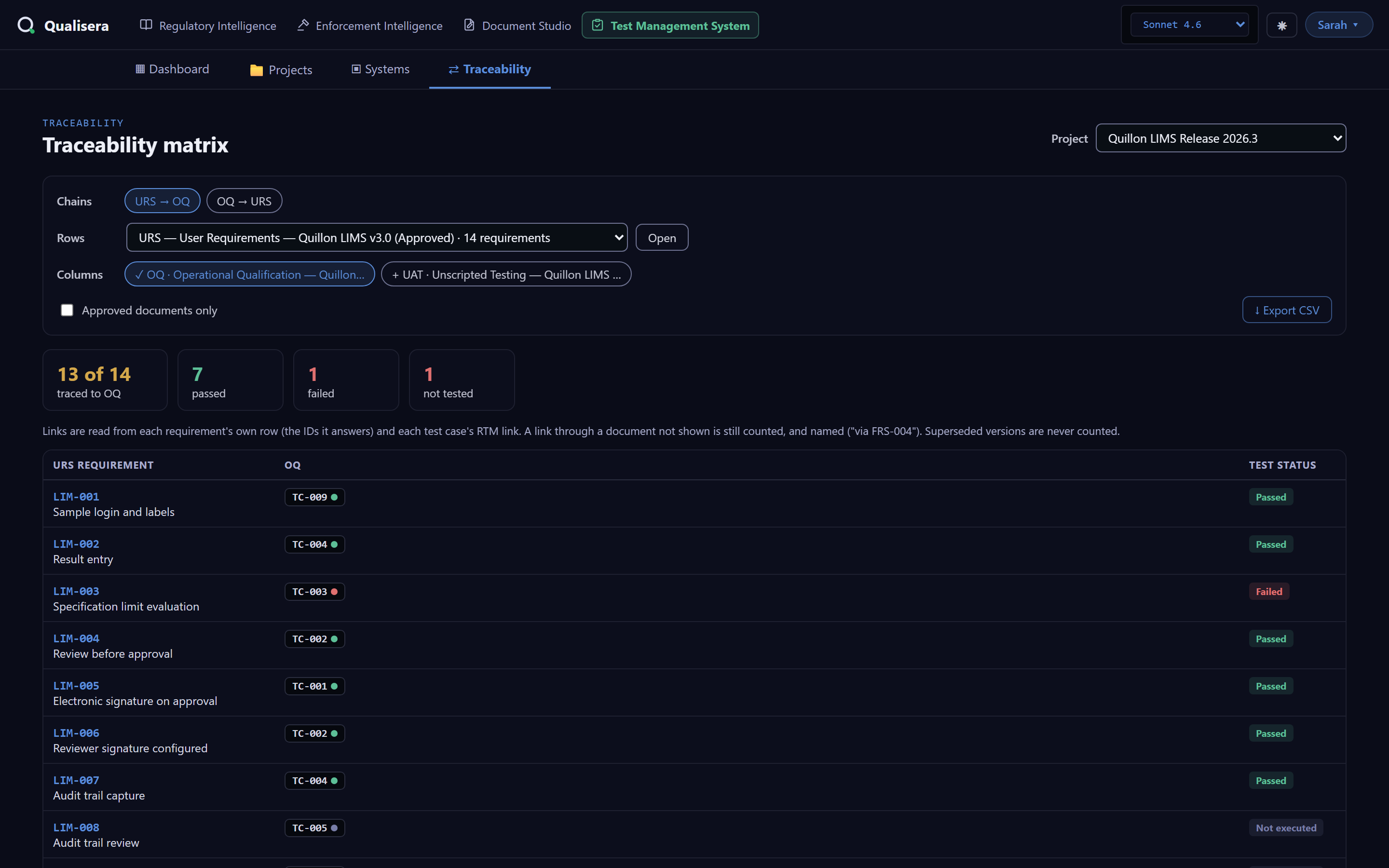
| User requirement | FRS | OQ test case | Result |
|---|---|---|---|
| LIM-003 Specification limit evaluation · Critical | FRS-007 | TC-003 | Failed · DEV-001 open |
| LIM-005 Electronic signature on approval · Critical | FRS-010 | TC-001 | Passed |
| LIM-008 Audit trail review · Major | FRS-012, FRS-013 | TC-005 | In execution |
| LIM-013 Dashboards · Minor | FRS-019 | Charter 2 unscripted | AI-inferred link · check basis |
Choose the chain to read: URS → FRS, FRS → OQ, DS → IQ, or the whole package. Requirements that reach no test, and links the AI inferred rather than found, are listed for review.
Discuss a validation workflow ↗ONE PROJECT / EVERY VALIDATION DOCUMENT
Software, equipment, utilities, rooms, and instruments each get the document types their validation calls for: plans, assessments, specifications, protocols, and reports.
Each line is new, a revision, an existing record, held elsewhere, or not needed with a rationale. Progress is read from the records themselves.
Draft from the documents upstream. Imported documents keep their wording; every gap becomes a question for the author to fill, accept, or decline.
Every requirement has an ID, priority, rigor, and rationale. Missing or duplicated IDs are flagged before a specification goes to review.
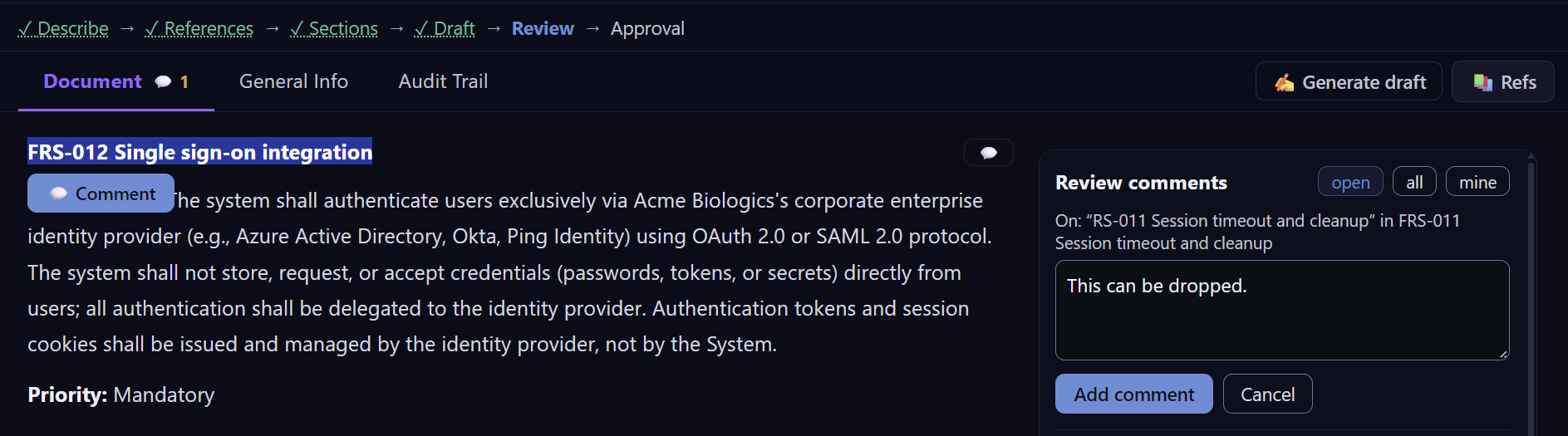
Reviewers comment on a requirement, a heading, or a passage. Approval waits for open comments, and signatures are verified against the signer's password.
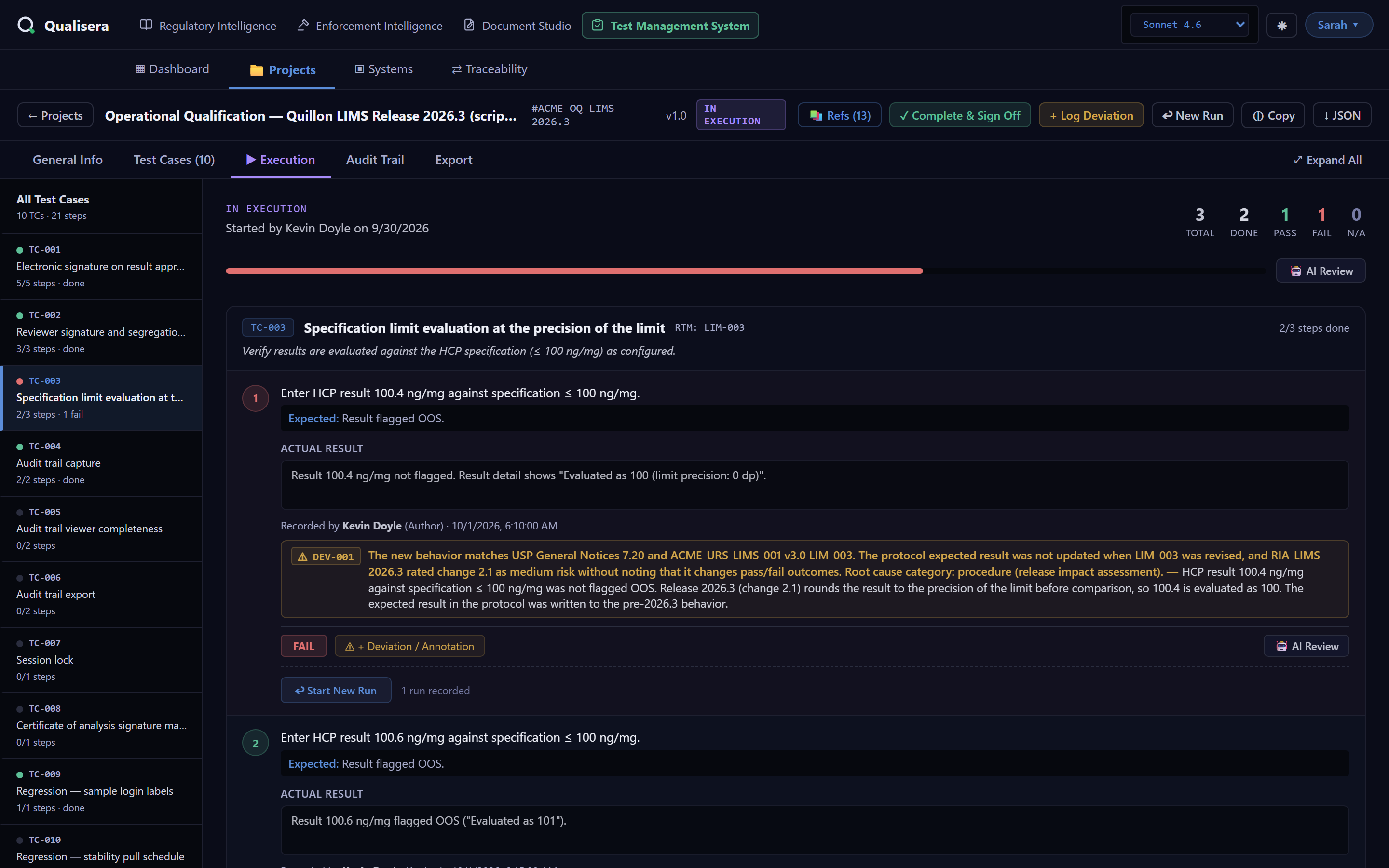
Testers record each step's result and evidence. A failed step raises a deviation that stays open until a corrective action is recorded.
Validation and test summary reports are assembled from results, deviations, approvals, and traceability, not written by a model. The author reviews the conclusion.
 PRODUCT SCREENSHOT
 PRODUCT SCREENSHOT
FROM PROPOSAL TO EXECUTION
Different roles make different decisions. Keep drafting, review, approval, and execution connected without treating an AI proposal as an approved test.
Checks test steps, expected results, and the basis of proposed requirement links.
Evaluates the protocol against the agreed scope and risk before authorization.
Executes the approved work and retains results and evidence for review.
OQ · Quillon LIMS release 2026.3 · TC-003 Specification limit evaluation · traces to LIM-003
| Step | Expected result | Actual result | Outcome |
|---|---|---|---|
| 3 | A result of 100 ng/mg is accepted against the limit ≤ 100 ng/mg. | Accepted. Screenshot attached. | Pass |
| 4 | A result of 100.4 ng/mg is flagged out of specification. | Not flagged. The value was rounded before the limit check. | Fail · DEV-001 raised |
The deviation stays open on the protocol and in the test summary report until a corrective action is recorded.
EVALUATE FOR YOUR INTENDED USE
TMS connects specifications, protocols, test execution, review, approvals, and authenticated electronic signatures. It is designed to support electronic-record and signature workflows under 21 CFR Part 11.
Agree on identity, authorization, signature meaning, audit history, and intended-use validation as part of your evaluation.
See the evaluation questions ↗SEE IT IN YOUR WORKFLOW
Start with a changed requirement, review the proposed test, and follow the evidence through execution.